
By Savannah Yancy, Respect Diversity Foundation Intern 2026
May 31, 2026, marks the 105th anniversary of the Tulsa Race Massacre that took place in the Greenwood district of Tulsa, Oklahoma, in 1921.
Disillusioned with the prejudices and laws of the Jim Crow-era South, wealthy Black entrepreneur O.W. Gurley purchased a 40-acre parcel of land in north Tulsa in 1906 with the purpose of creating a prosperous Black community. His dreams were realized when the district grew rapidly into what Booker T. Washington called “Black Wall Street.” With the help of fellow businessman J.B. Stradford, Greenwood became a thriving, self-sufficient community with various Black-owned cafes, hotels, banks, movie theaters, libraries, grocery stores, schools, and homes.
After WWI, segregationist sentiments and KKK activity were abundant in the American South. Instead of being celebrated and appreciated for their sacrifices in the war, Black soldiers and veterans were met with disdain and apathy upon returning to the states. These increasingly discriminatory attitudes culminated in a series of racist attacks in 1919 that later became known as the “Red Summer.”
And so, the historical stage was set on that fateful day in May of 1921 when Dick Rowland, a young Black man, got on an elevator with Sarah Page, a young white elevator
operator. What occurred after this is unclear. Some reports suggest that Rowland attempted to assault Page, while others contend that he merely bumped into her after
being knocked off balance by a machine malfunction.
This part of the story frequently draws comparisons to that of Emmett Till, who was brutally beaten and murdered by two white men in 1955 after being falsely accused of
cat-calling a white woman. He was 14 years old. Press coverage of the initial story was biased and inflammatory. After Dick Rowland was arrested for the alleged crime, the Tulsa Tribune ran this article on the morning of May 31, 1921:
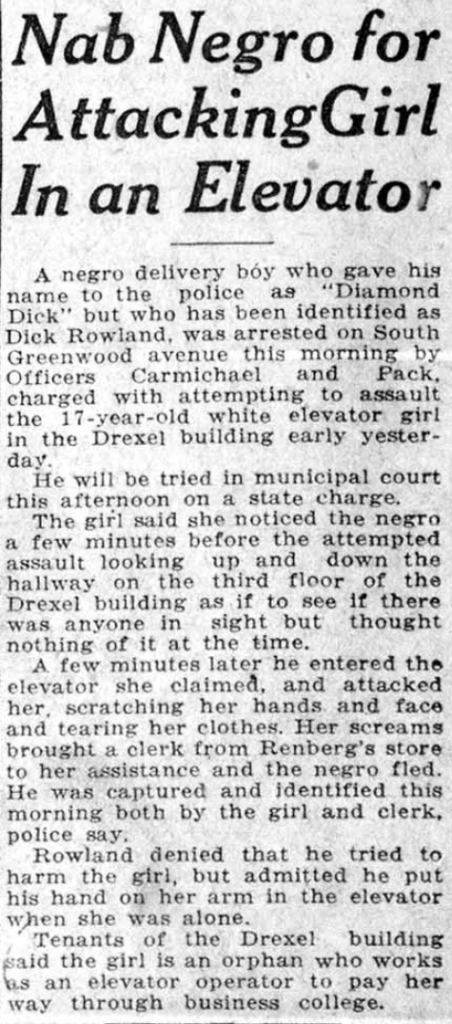
At Rowland’s arraignment, a crowd of both white and Black men gathered outside the courthouse. The white men came with the intent of confrontation, the Black men, with the intention of protecting Rowland from mob violence and lynching. It should be noted that all charges against him were later dropped due to insufficient evidence and a letter to the court from Sarah Page herself stating that she did not wish to press charges.
After tensions came to a boiling point between the white and Black men outside the courthouse on the night of May 31, 1921, a mob of white citizens set upon Greenwood. What followed this courthouse confrontation is one of the worst and deadliest massacres that has ever occurred on American soil. Once the first shots in the standoff were fired, swaths of white men were deputized by Tulsa city officials. They were given guns and ammo to reign terror on the citizens of Greenwood. Outnumbered and outgunned, the group of Black men retreated to their district with the hope of protecting their businesses, homes, and families.
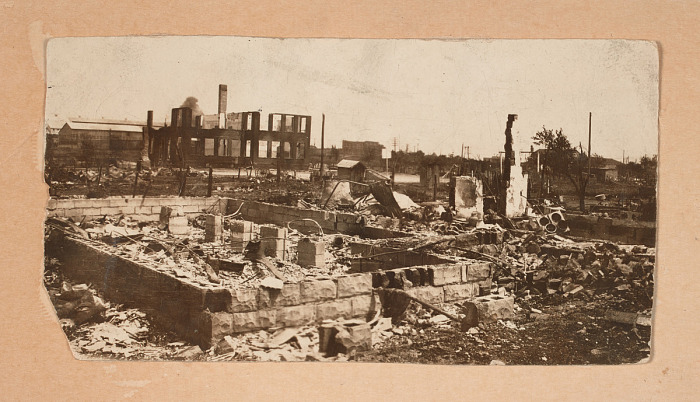
Plumes of smoke rise from buildings in Greenwood as onlookers watch.
National Museum of African American History and Culture Archives.
The armed white mob followed, blindly firing shots into the night and setting alight almost every building in their path. They senselessly destroyed Black churches, schools, libraries, banks, hospitals, and other thriving businesses in the community. According to the Red Cross, more than 1,200 homes were completely destroyed, and an estimated 215 were looted. The initial death toll for both white and Black Tulsans was estimated to be around 36, but new evidence suggests it could be over 300. Thousands were left without homes, and many had their livelihoods completely decimated in one night of carnage. Still, no white men were ever formally charged for the destruction of the once-flourishing district of Greenwood.
On the afternoon of June 1, the Oklahoma National Guard arrived among the smoldering ruins of what once was Black Wall Street. But they did not offer supplies, medical care, or reassurance to the residents of Greenwood. Instead, they arrested and detained them in holding centers under martial law. They were only released if they had an employer or a white person to vouch for them, which meant that some citizens remained in detention for days. This included the 800 victims of the attack who were severely injured or maimed, some of whom were children. The media worked in tandem with insurance companies to tout the race massacre as a riot to avoid paying out claims.
The Oklahoma National Guard descended upon Greenwood after the massacre.
National Museum of African American History and Culture Archives.
In the years since 1921, there has been a concerted effort by both state and federal governments to cover up the history of what happened to Black Wall Street and its inhabitants. Officials have attempted to silence survivors, suppress data, and discourage education about the massacre. Oklahoma public schools were not mandated to teach about what happened in Greenwood until 2002, 81 years after its occurrence.
Though efforts have been made to repair the damage done both socially and physically to Greenwood, the burgeoning community never rematerialized. The victims of the massacre, as well as the land in which Black Wall Street once stood, had been forever scarred and changed by that day. The Tulsa Race Riot Commission Report, published in 2001, attempted to detail the toll this attack has had and continues to have on the many Black residents of Tulsa, but fell short of this goal and has been criticized for using biased and insensitive language. Most notably, the inclusion of the misnomer “riot” in place of “massacre,” which we previously learned was only labeled this way by insurance companies to avoid paying out claims to victims.
In recent years, there has been pushback from Oklahoma state officials against teaching about the Tulsa Race Massacre, as well as Critical Race Theory and other related topics. HB1775, introduced into the Oklahoma legislature in 2021, effectively banned the teaching of subject matter that could suggest that “an individual, by virtue of his or her race or sex, bears responsibility for actions committed in the past by other members of the same race or sex” or that “any individual should feel discomfort, guilt, anguish or any other form of psychological distress on account of his or her race or sex.” Though the language in the bill is intentionally vague, it was passed in May of 2021 by Governor Kevin Stitt. The controversial bill was challenged by the ACLU in 2024, but most of its provisions still stand. The only amendments made to it excluded universities from the strict requirements, though they are still not allowed to require any sort of diversity training or orientations that focus on discrimination based on sex, race, or gender.
The Tulsa Race Massacre represents a dark blight on America’s checkered history with race relations and mob violence. Thousands of Black Oklahomans were killed, injured, and displaced due to deeply entrenched racism and discriminatory laws and practices. Though the Civil Rights Movement later made great strides in ensuring something like the Tulsa Race Massacre never happens again, a conscious effort needs to be made by every citizen every day to guarantee the safety and prosperity of Black communities.
Sources
https://tulsahistory.org/exhibit/1921-tulsa-race-massacre/
https://www.history.com/articles/tulsa-massacre-black-wall-street-before-and-after-photos
https://www.tulsalibrary.org/black-wall-street
https://blogs.loc.gov/loc/2021/05/how-to-research-the-1921-tulsa-race-massacre/
https://www.history.com/articles/tulsa-race-massacre
https://www.okhistory.org/research/forms/freport.pdf
https://blogs.loc.gov/headlinesandheroes/2021/05/tulsa-race-massacre-newspaper-complicity-and-coverage/
https://legiscan.com/OK/text/HB1775/id/2387002
https://www.aclu.org/press-releases/federal-court-partially-halts-oklahomas-classroom-censorship-law